Pages

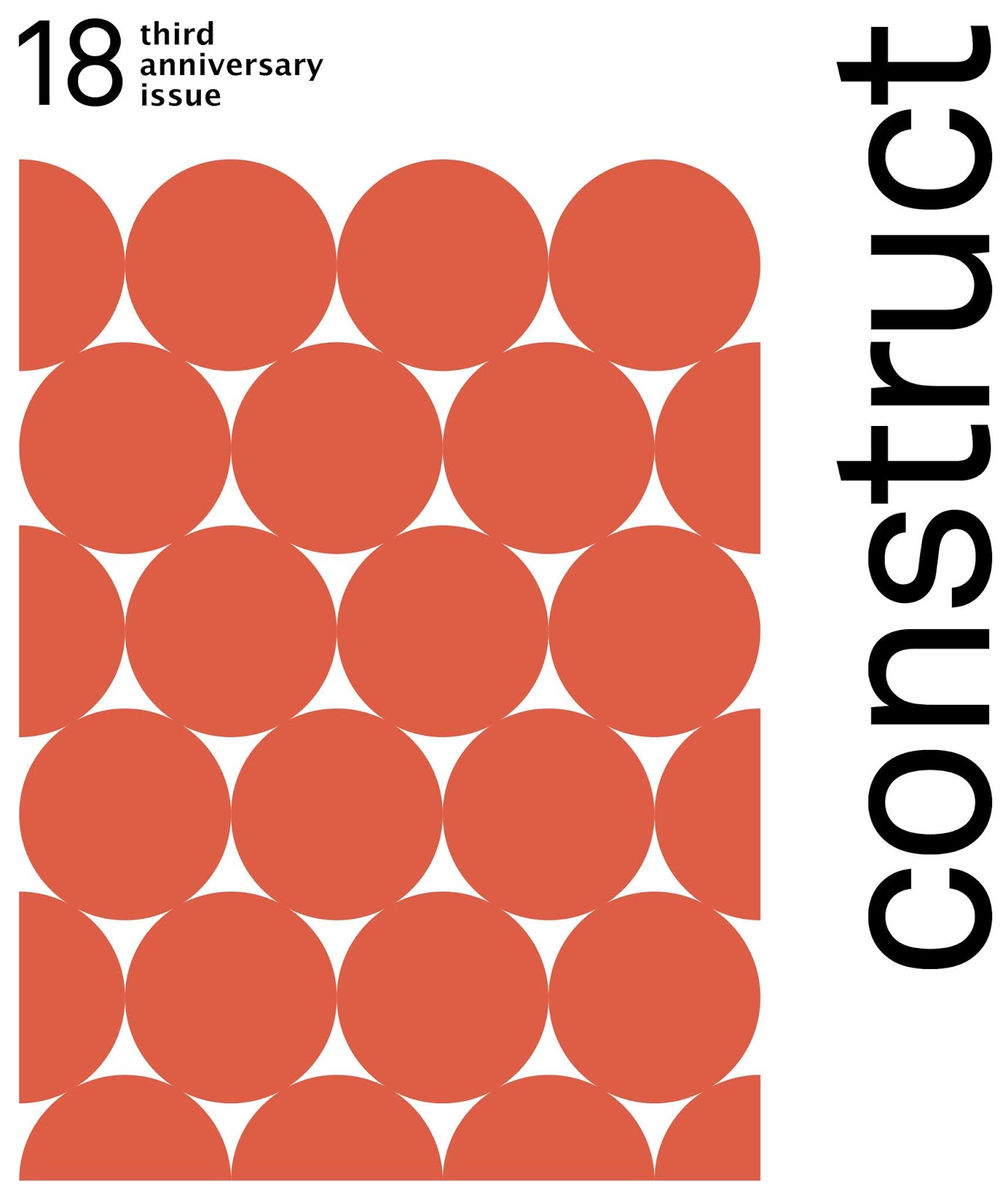
Construct #18 - Third Anniversary Issue


Years passed by and our words end in us.

This oral city, full of crowns and empty houses.

Don’t waste your sympathy on us. The sky is already packed with it, birds that screech of all the terrible things that might happen. And behind them, timeless bells transforming to the metal stains of what has already happened. And behind all of that is the image of our children, tracing out the fixed raptures of what ought never to have happened.

Should we even bother with optimism, at all? We don’t have a choice. We can’t afford to give up the dream, but we will also be woefully unprepared if we don’t face and examine the nightmare, even acknowledge the ways in which the threat of oblivion spurs us forth to create something better. Our fear and hatred are still justified.

Can words ever be physical? Perhaps.

Can our poetry ever be our only important gesture? Sure.

The matter of writing is ultimately capable of bringing abstraction, and even the integral repetition of language itself, to its end, to its silencing. But we could expel abstraction from the contemporary world, and focus instead on the immediately gestural and physical.

But how physical can poetry be?

Where Rimbaud wishes to liberate himself from the “laws, moralities and customs” of the bourgeois civil order, Nechayev refuses the ecstasy of that liberation and bolts himself to the cruel center of that same order. In seeking to express the absolute negation of everyday physical reality, Nechayev becomes the personification of its basic banality and brutality.

It is an understanding of the possibilities of poetry beyond words that sounds almost hopelessly utopian now.

The writings of Jean Genet and the Situationists, for example, even given the pitches of rage and icy violence each of them reached, are soaked in revolutionary optimism. Victory, as far as all of these writers were concerned, was inevitable.

So here’s a little bit of advice:

1. Don’t take your children to rallies, art fairs, museums, or the countryside, to see the beautiful nature and whatnot.


2. Don’t teach them any local hymns, or tell them stuff about clean water. 3. No. No. No. 4. Make them stand in the rain. 5. Talk to them about torture, talk to them in cries and groans.


6. Walk with them for days across the starkest of plains. Let them see the working conditions of people in their darkest hours. Then they will know how pointless it is to listen to those who would praise the color of the sky.


7. They will want to go to dirty places around the suburbs of Jakarta. There, they will stare at you and you will fall to the ground, as horrified as anyone who has ever really listened to a bird’s song.


8. Do not befriend them. Stop wasting your time. They will not talk like your Instagram buddies, and they will not laugh at your memes. They will build many barricades, and will not walk around carrying hashtags. Instead, they will bring one stratagem after another.


9. They will make huge additions to your memory.


10. Then they will again tell words—small stories—about the knowledge of those who know they have nothing.


Contents
1. Today's Skin For Yesterday's Ceremony
2. To Victory
3. New Meat
4. Reflections of Delayed Hope
5. A Plantation in the Sky
6. On Being A Woman
7. Desolate
8. Linen and Coat
9. Half Woke Kids Trying to Correct the World


Click here to download Construct #18.

Construct #17 (June 21, 2018)

"One cannot imagine the fragility of human life until she has caught a glimpse of Death’s fragrance. We couldn’t shake the faintest moment when the Black Boned Angel sent a spine-tingling sensation that could condense 60 years of life into a 6-second-long flash of memory. It’s a sudden glitch in our head, a cold sweat on our pounding chest. Our body knows, even when our head said she’s got nothing to worry about.

Those greetings from Azrael came to each person in their own unique way. It cannot be replicated, nor multiplied; one could extract the pattern, but the exact moment couldn’t be reproduced. So Death, in all its might, is that friend that no one else had. Maybe he sent those greetings in your travels, when you had to hit the brakes to avoid a giant truck. Maybe he came to whisper a few words when you ate that last piece of meat. Maybe he manifested into a fatal combination of liver, lung, and heart failure when your kids have all grown up. Or maybe he came every day, creeping behind your shadows, and chipping away at your lifespan like an old paint job.

Nowadays the cold tide of Death has swept our families, friends, colleagues, neighbors, comrades, in a much more subtle and grueling signal. We see them struggle just to keep their heads quiet and their feet idle. We help them to wake up and welcome the sun each day. We sit by their side when they’ve been awake for too long. We come running when they try to tear up their veins. We try and try, and yet Death welcomes them like an old friend, or a nice warm bath.

One has to imagine that there are better days than this; the ones when our Future doesn’t seem like the inertia inside the belly of a rotting beast. When the car is on fire and there’s no driver at the wheel, would you give in to Death? Or would you rather build another Future, the one where the paving stones end at the Beach?"


Contents

1. Fragments of Spacers
2. You Caught Me On A Bad Day (Again)
3. Drive-Thru
4.  Loyalty, Totality


Click here to download Construct #17.

Construct #16 (April 17, 2018)

"When Prometheus stole fire from High Establishment he gave us a promise of
carnage, but also a reason to assemble. We feel it now, in our bones, this inheritance
of loss: the carnage continued as the assembly boiled down into the plastic assembly
line of surrender.

Nowadays we look to past ashes as the soothsayer approaches tea leaves, even as we
are backed into a thousand corners. Unborn children too, eavesdropping from their
mothers’ wombs on the strange hell outside, understand that every point is populated
with heartbreak—every line has become an intersection, every corridor a cul-de- sac.
Born aflame they soon realize that each defiant gasp of air is a beheading
momentarily postponed.

At this critical juncture, perhaps what we secretly crave is to admit defeat in the face
of so much rot. It just might be that only then, within that plot twist of revolutionary
act, will we uncover the hidden whispers necessary to reforge our ties and rebloom
our clasped hands. It is important now more than ever to violently trust each other
with our lives: the road to perilous humility will only become steeper, while the toll
gate to premeditated regret is forever displayed in HD, haloed and in vogue, ready to
consume and be consumed.

Maybe the children know the answers; maybe they have always been trying to tell us.
Their cries remind us that all human screams speak in the same flagless tongue of
horror."


Contents

1. Around This Campfire
2. Things
3. Native Speaker
4.  Self (Dis-Covery)
5. Eat A Kid, Carpe Diem


Click here to download Construct #15.


Construct #15 (February 12, 2018)

“New year, new beginning” 

The quote above is, unfortunately, nonsense. 

We’re still trapped inside this machine, still comfortable with loads of mind-numbing substances as a living monument, shoved down our five senses from left and right, above and under. 

Regrets, fear and doubts of the past become our barricades. It’s not surprising that the future we wanted never came; it was shadowed by lies and deceit. 

“History repeats itself,” as Marx says, “first as tragedy, then as farce.” 

But, in between space and time to contemplate, there’s our chance to give life another shot, to live to the fullest and seize everything day by day, to grasp every meaning and make it a weapon of the mind. 

To give meaning to our existence in this new year and new beginning is to take back the chance to scream at the top of our lungs: 

“We have not perished yet!”


...as we go back to our routines. 


Contents

1. Exclamations of Disquiet
2. Ziarah
3. The Email
4. The Brief
5. Higienis
6. Sebuah Kiasan
7. On Revolutionary Honesty

Click here to download Construct #15.

Construct #14 (November 6, 2017)

Menaruh harapan di tempat yang salah adalah awal mula keruntuhan.

Yang bisa diandalkan tentu tak pergi, tidak terhubung jauh artinya dari menghilang. Paham belum tentu diraih karena sering bicara.

Makna menumpuk di hulu telinga lantaran terlalu sering bertukar kata,. Sementara hilir lisan kerap menjerat buah pikir setengah tanggung, kemudian menghanyutkannya ke jurang basa-basi.

Pola serupa berulang terus; ya, tidak, bukan, itu, maksud, saya?

Bahasa dikerangkeng bak tahanan politik, disuapi makna hingga bibirnya dihinggapi lalat. Bagai memerlakukan pohon seperti bayi.

Ini bukan silap lidah.

Buahnya akan tumbuh walau dihampiri codot tiap petang. Namun, anak yang gagal disapih tak hanya merepotkan, juga akan mengecewakan.

Namun, jangan dulu salah kita timpakan pada bibit, tahu apa dia soal urusan orang dewasa? Bukankah agen rasional seharusnya tahu persis cara paling cepat berlindung di bawah bayang pohon rindang adalah dengan membantunya tumbuh?

Perkaranya datang ketika tunas dianggap ringkih, saat kemarau bertamu dan menggiringnya pada kekeringan. Kekuatannya dipaksa bercermin dari sekeras apa ia bertahan. Ketika penghujan habis nanti-nanti, ia diawasi sepanjang kala, khawatir belum sanggup belajar tenggelam.

Jika begitu maka masalahnya adalah kita. Bagaimana cara menyelesaikannya?

Jawaban vulgar tentu menunjuk hidung kembar siam tragedi dan komedi. Jawaban lain butuh mengeruk pengalaman, yang belum tentu dipunya sepasang mata.

Kerapuhan kita, tak sama dengan kerapuhan bahasa. Ringkihnya kaki kita, berbeda dengan akar mereka. Lebah bukanlah kebun. Virus berlainan dari inang.

Sampai akhirnya di pucuk tahun waktu menyesal datang juga. Di masa ini kita berharap, menguburnya dalam-dalam agar tumbuh lebih kuat dan berguna.

Kali ini, kita harus menanamnya di tempat yang tepat.


Contents

1. Teritorial Mati
2. Physics of i 
3. Demam Ketakutan
4. the Art of separation
5. On Desire and Other Misplaced Things
6. Kondisi
7. Kembali Berangkat Kerja

Click here to download Construct #14.

Construct #13 (September 5, 2017)

We live in a society that’s pushing us further and further into ourselves.

A cornered rat can bite a cat…they say
but they also say a lot of other things
about rats that are left to die and rot
we’ve been pushed and shoved by bullies
masquerading as friends and devoted lovers
Fuck fakers! Fuck fakers! we chant in our little bubbles
and there’s definitely a whole lot of fuckin’ and a lot of fakin’
and just because we chant doesn’t mean we don’t do it too
that’s all it takes for us to stay in our caves
we hoard the darkness of our times while hoping that
the light from a little rectangle is going to illuminate our minds
the little rectangle that tells us to love and tells us to like
and tells us to type shit we don’t mean just so people will
love us and like us in return even if they don’t mean it either

We live in a society that’s pushing us further and further into ourselves.

We are confused and we don’t want to admit it.
We are lab rats lost in a maze
because we forgot what cheese smells like.
We are exhausted and exhausting ourselves even further
by turning to short-term remedies that work for a while
but then what? But then what?
Then we wait. Then we find others who are also waiting.
Then we talk about what to do about this whole situation
and we wriggle out of denial together.
We crawl out of our caves.
We invent new expressions in which
there’s no reason for a rat to bite a cat
because there won’t be any corners to be backed into.


Contents

1.  C10H12N20
2. On Her Own Terms
3. I Had a Door
4. For Lovers

Click here to download Construct #13.

Construct #12 - Second Anniversary Issue (July 4, 2017)


It’s been two years since we started this. And in those two years, we have not yet come to witness the inevitable destruction of everything that we were against. It’s not enough. For a brief period of time, it seems as though we have finally arrived at a certain point, but in reality, we keep running out of space. We wander together, we fight each other, we predict a riot and do not condemn it, we share a meal, a bed, we fall in and out of love, but we have not yet come to a fiery conclusion. And we know that is not acceptable.

Where are we going? That is the big question. And to be perfectly honest, it hardly matters to us now.

We are fully aware of this strange war we’ve entered, and that this war requires the production of worlds and languages, the opening of places, the building of homes, in the midst of disaster. It’s a perpetual eviction. Everything which today constitutes an acceptable landscape for us is the result of bloody violence and conflicts of rare brutality. And in many cases, those people in high places—they want us to forget. Really, really, want us to forget. Forget that the city has devoured the countryside, that the factory has devoured the city AND the countryside, and that institutionalized ignorance—tentacled, deafening and without repose—has devoured everything. This observation, of course, doesn’t imply regret or the feeling of defeat. This observation implies: seize everything.

That includes fiction. Mundus est fabula, meaning, the world is fiction. Fiction is a serious thing. We need fiction to believe in the reality we are living in. We believe that our present war is about giving this deserted fiction a new kind of content. And in giving this new content, just like in the art of war, it is sometimes better to produce places and friendships than weapons and/or shields. Whoever found their place, occupies. Whoever goes into exile, exiles. Fiction is the stranger who stays and takes with him the barricade. Fiction is the stranger who leaves and takes with him the inhabitable city.

But how about our reality? Our loss is not any less real than our victory. Over the course of our lives, AND our history, we have suffered too many losses, and witnessed far too many disappearances of everything we love.

It is the fathers who were the first to disappear. They went to work; to the farm, to the street, to the factory, to the office. Then the mothers, doing the same things the fathers did. And each time, we realize that it wasn’t really a father or a mother who disappeared—it was a symbolic order, a world. The world of the fathers vanished first, then that of the mother. And this loss was so incalculable, and the mourning so total that no one can agree to go through it.

And it isn’t just masculine exploitation that’s involved here; it’s something located at the intersection between patriarchy and capitalism, in an economic domain. Because the economy is ruled by the law of desires—and everything that is an object of desire, even if it’s a subject—is included.
For all we care, Engels could say all he liked about the family, that within the family the woman is the proletariat and the man is the bourgeois, since the man is publicly recognized, and the woman is exploited. But his comparison hits the wall of the fact that in society the bourgeoisie gives no pleasure whatsoever to the proletariat, and love or desire only play minor roles in their relations. Even today, the family and familialism continue doing marvelously well, and end up invariably reconstituted as false alternatives in capitalist relations.

It is clear to us then, that they do not want us to take other forms of relations besides that of the desire for the couple or family. What they really want from us is this desire for a neo-matriarchy which would automatically take over a dead patriarchy. And we believe that there is no revolt more absolute than the one that denies this benevolent domination, this warm power, this motherly embrace.

So, in order for us to go on, we have to ask ourselves again tirelessly, of what we are, how we got here, who our brothers and sisters are, and who exactly our enemies are. All these questions, to us, are no longer a mere pastime for intellectuals on an introspection trip, but an immediate necessity.


Contents

1. Scribbles #2: Confronting the Family
2. Tradisi Sampling dan Hantu Masa Lalu
3. Lessons on Womanhood // Sunda Syarifa
4. 1–4 // Soda Api
5. Sirene Sunyi Senjakala Berhala
6. Rumah Serang // Ani
7. Antipoesia: 
Bentuk Puitik Pasca Kemunduran Garda Depan 
di Amerika Latin

Click here to download Construct #12.

Construct #11 (May 1, 2017)

Our entire history in a way is made up of constant articulation and rearticulation of Narratives—Narratives that work like tangling lines of stories that we tell ourselves to make sense of who we are, our purpose, and our relation to others. Stories woven, within and around us, ad they give meaning to our very existence.

Like those who came before us, we seek to define the meaning of meaning itself. More often, we stop at the dead end of Personal Narratives—as it is something that would comfort us the most, while giving stability to our sense of self. That the world is a playground or a stage to which we would conquer from one level to another.

While on the other end of the spectrum, our Collective Narrative dictates who we are in the larger scope of things—what song to be sung in what uniform with which color for which flags by whose father's fathers who had found which land... There are more tangled strings between those Narratives than we would like to admit.

Yet often we choose to forget, if not ignore, the much subtler web of strings that strangles us in the first place: the materiality of the narratives or an entirely different history and context that by itself makes those narratives possible.

Our Reality works as our bounded Narratives and vice versa, our Narratives as our bounded Reality. We'd rather choose to believe that it's solely us who articulates how the world was/is/should be—while dismissing the role of 'the world' (or things that are beyond us) in articulating how we were, what we are, who we will be.

Would it be enough to just let ourselves get tangled in the mess that has always been? And if there are no better ways to detach ourselves from that mess, would there be a much subtler blade that we can grip onto in order to cut it off?

Let us hope and strive for it—that it's neither to give in nor to cut loose, but rather to refine and make them clear. And by that, we shall rearticulate what needs to be.


Contents

1. Bright Future
2. She Who Was Generous with Her Joy
3. Scribbles #1:
Conversing with Children
4. We Are as Dead as Can Be
5. Sambutan
6. Untitled
7. Ribelli (Rebels)
8. Collega Il Passato Con Il Futuro
(It Connects the Past with the Future)

Click here to download Construct #11

Construct #10 (March 6, 2017)

We rarely realize how easily and passionately we comment on, mock or even condemn phenomena that in truth are irrelevant to our surroundings. But even more disconcerting is the fact that we treat chirps, whose sources are questionable to say the least, with the same empty intensity.

This aggressive passivity has turned us into experts in hiding and cowering behind gadgets. And as a result, we have become increasingly detached from the information that those gadgets constantly feed us and vice versa without understanding the consequences of the entire affair.

Whether we realize it or not, we are suffocating from the pollution filling up the two worlds we simultaneously inhabit: the physical world and the Internet. The sad truth is that we have no one but ourselves to blame in both cases.

It is not easy to confront our own mistakes. It makes us question ourselves. The voices unceasingly ask the haunting question: Who will win this fight—you or yourself?

But though it may seem bleak, there is still hope. It lies in our responsibilities to contemplate and act accordingly. Only we can change the way we live in our worlds because if we truly try to understand and better our surroundings, along with the many things that occur within it, we will be able to slowly free ourselves from indifference.

By cultivating an interest in learning about the many events that shaped and continue to shape history, and therefore our lives, we will hopefully become more adept at avoiding the tight grips of rumours and ignorance.


Contents

1. Another Reason to Be Together
2. Strictly Professional
3. A Call
4. Withdrawn
5. Analisis Sajak Pier Paolo Pasolini:
Kondisi Imanen Dalam
Pembentukan Ideologi Fasisme
6. Matinya Teori dan Transgresi 
Dalam Karya Seni:
Sebuah Refleksi Kritis Dari
Seorang (Mantan) Praktisi Seni
Mengenai Performans "Makan Mayit"

Click here to download Construct #10.

Construct #9 (January 2, 2017)

Here we go again.

After the instant decay of our willingness to understand one another, we start to dig our trenches deep enough, thus rendering every attempt to know The Other and vice versa. That gap is slowly morphing into a cliff, refusing to be crossed. No bridge, not even a line of rope, could exist in a widening gap.

This world and our surroundings are changing rapidly—too fast for some us, and running into directions we did not anticipate, nor understand. We look around and all we see is a strange, incomprehensible place.

As usual, many of us then panicked and unconsciously submit ourselves to be pawns for clergies, oligarchs, and the State. We are not even playing.

Like those before us, we felt that we could no longer hide under a tree's shade; instead we came back crawling to our caves, hoping that the world and those who we did not understand magically roll back to a less angry place and humans we could live with. We left The Other being poisoned with hate, fear, and ignorance every day.

That was our mistake.

We cannot give up; even though it is painful to change our surrounding and reach an understanding with those we love. To give up is simply to let our ignorance, fear and hate, dominate our lives. We have to keep trying to recongnize this world and our surroundings, how it moves and what caused them to explode.

The sun is already here, why not fly closer to it?


Contents

1. Pekan Kejam
2. A Pause
3. What Has Been Spilled
4. Seasick
5. André Breton, Marxisme
dan Revolusi Surealis
Yang Tak Selesai

Click here to download Construct #9.